
Important Update to U15 & U18 Programs – Checking & Non-Checking Streams
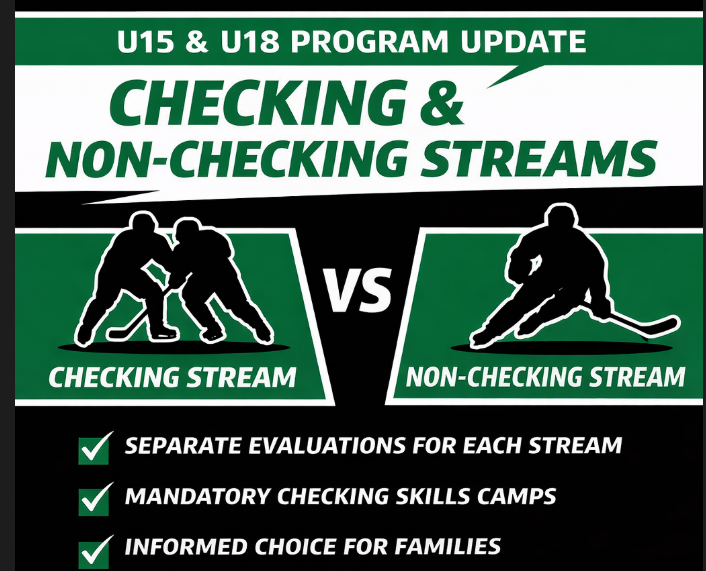
As we begin preparations for the 2026–2027 season, Sherwood Park Minor Hockey Association will be implementing an update to how our U15 and U18 checking and non-checking divisions are structured and evaluated.
Beginning this season, checking and non-checking hockey will operate as two completely separate streams within the U15 and U18 programs.
What is Changing?
During registration in U15 & U18, players will be asked to select one of two streams:
- Tier 1–3 (Checking)
- Tier 1–3 (Non-Checking)
Players will be evaluated and placed only within the stream they select during registration. This represents a change from the approach used in previous seasons, where players who selected checking were initially evaluated in that stream but could ultimately be placed on non-checking teams if they did not secure a spot within the available checking rosters.
Why We Are Making This Change
Historically, SPMHA has seen significantly more players request placement in the checking stream than there are roster spots available in those divisions. Under the previous model, this often resulted in players beginning evaluations in checking tiers but later being moved into non-checking placements due to capacity limitations.
While this process was intended to provide flexibility and ensure appropriate placement, it frequently created confusion and frustration during evaluations.
Moving to two clearly defined streams will:
- Provide greater clarity and transparency during evaluations
- Allow families to make a deliberate choice about the style of play they prefer
- Ensure players are evaluated only against others in the same stream
- Simplify the overall evaluation process for players, coaches, and evaluators
Understanding Checking vs Non-Checking Hockey
Body checking introduces an additional physical component to the game. While many players enjoy the competitive nature of contact hockey, research has consistently shown that injury risk is higher in streams that allow body checking.
Canadian studies examining youth hockey players in Alberta and British Columbia found that leagues without body checking experienced:
- Up to 70% fewer overall injuries
- Approximately 57% fewer concussions
- Substantially fewer severe injuries
Other Canadian research has found injury rates roughly 50–60% lower in non-checking leagues compared with leagues where body checking is permitted. This information is provided to help families make an informed decision about the stream that best fits their player’s comfort level, experience, and style of play. Both streams offer competitive hockey and meaningful development opportunities for players.
Checking Skills Requirement
To help ensure players entering the checking stream are prepared for contact hockey, SPMHA will now require that:
Players who have not previously played in a checking division MUST complete a checking skills camp prior to evaluations.
This requirement may be satisfied through:
- An SPMHA checking skills camp, or
- A recognized third-party checking clinic
These sessions focus on key safety and technique elements, including:
- Proper body contact technique
- Angling and positioning
- Receiving contact safely
- Board play and puck protection
- Awareness and injury prevention
Upcoming Checking Skills Opportunities
SPMHA will be offering several opportunities for players to complete this requirement.
2026 SPMHA Spring Checking Camps – April 11 & April 26
Registration: https://app.teamlinkt.com/register/find/spmha?cid=66723
SPARK Summer Camps – Checking Skills – August 10–14 & August 17–21
Registration: https://app.teamlinkt.com/register/find/spmha?cid=63930
These camps are recommended for any player planning to participate in the checking stream this season.
FREQUENTLY ASKED QUESTIONS (FAQ)
Will players be able to move between streams during evaluations?
Players will be evaluated within the stream selected at registration. Changes may only be possible prior to evaluations beginning and will depend on available roster space.
Does non-checking mean there is no contact at all?
No. Hockey remains a physical game. Incidental contact and battles for the puck still occur, but intentional body checking is not permitted, and is penalized.
Will both streams still have multiple tiers?
Yes. Each stream will continue to include multiple tiers of play to ensure balanced competition.
Who needs to complete the checking skills camp requirement?
Players who have not previously played in a checking division and wish to evaluate in the checking stream.
Is there research comparing injury rates in checking vs non-checking youth hockey?
Yes. Several Canadian studies have examined injury rates in youth hockey leagues that allow body checking compared with leagues that do not. Research conducted in Alberta and British Columbia has found significantly higher injury rates in leagues where body checking is permitted. Some studies have reported up to 70% fewer overall injuries and approximately 57% fewer concussions in non-checking leagues, with additional research showing roughly 50–60% lower injury rates overall when body checking is removed at certain age levels.
These studies were conducted using Canadian youth hockey leagues and have been published in peer-reviewed medical journals. Families interested in reviewing the research can find additional information at the links below:
- https://bjsm.bmj.com/content/56/1/12
- https://bjsm.bmj.com/content/54/7/414
- https://pmc.ncbi.nlm.nih.gov/articles/PMC3153513/
- https://jamanetwork.com/journals/jama/fullarticle/186037
- https://caringforkids.cps.ca/handouts/safety-and-injury-prevention/bodychecking_in_ice_hockey_what_are_the_risks
As with any sport, hockey carries inherent risk. These studies are provided to help families make an informed decision about whether the checking or non-checking stream is the best fit for their player.
Additional Details
More information about registration timelines, evaluation schedules, and team structures for the 2026–2027 season will be shared in the coming months. Registration for the 2026-27 season is targeted to open June 1st.
If you have questions about the new stream structure, please feel free to reach out.